"It helped that we had a clear, dry, day and calm water. Our guides gave us good insight on how to observe signs of marine life. We saw little blue penguins, pods of 100 or more dolphins, a fur seal, plus one of the extremely rare Bryde's whales. The crew are not just in this business to line their own pockets, they are marine scientists, dedicated to the conservation and protection of marine life around North Island, so very happy that our money helps to fund these worthwhile projects."
Hauraki Gulf
Auckland Whale Watching
Half a day on the Gulf, from $124.
From
$124
per person
Free cancellation
- 4.5 / 5 1,275+ Reviews
- 4.5 hours Duration
- 65 ft Catamaran
- 2nd Cruise If No Mammals Seen
- Free Cancellation
Book Your Experience
Check Availability & Prices
Select your preferred date and time. Instant confirmation — free cancellation up to 24 hours before departure.
The Experience
What the Whale and Dolphin Safari Includes
Our top pick: 4.5 hours on a 65 ft catamaran from the Viaduct.
Highlights
- 4.5 hours searching the Hauraki Gulf Marine Park for whales, dolphins and seabirds
- Sail on the Dolphin Explorer, a 65-foot catamaran
- Pass North Head, Devonport and Rangitoto Island on the way out
- Commentary from the skipper and time with marine researchers on board
- One dollar from each ticket supports the Hauraki Gulf Guardians fund
- Departs from the Eastern Viaduct in central Auckland
What's Included
- 4.5-hour eco cruise on the Hauraki Gulf
- Guide and skipper's commentary on the wildlife
- Sightseeing past North Head, Devonport and Rangitoto Island
- A free second cruise if no marine mammals are seen
- A one-dollar contribution to the Hauraki Gulf Guardians fund
Booking a Whale Watching Cruise
Four steps from this page to the Gulf.
Choose half a day or an islands day
The safari is a 4.5-hour wildlife trip. The Tīkapa Moana cruise pairs a wildlife search with a stop on Rotoroa Island or at Man O' War on Waiheke, and runs most of the day.
Check in at the right Viaduct berth
The safari's catamaran leaves from the Eastern Viaduct. The islands cruise checks in at the Explore booking kiosk in Viaduct Harbour, 15 minutes before departure.
Take seasickness tablets before you board
Both trips head into the open Gulf, which is more exposed than the inner harbour. The safari's listing advises taking seasickness medication before the trip, not once you feel unwell.
Keep your booking for the guarantee
If no marine mammals are seen, the safari gives you a free voucher for another trip that never expires, used on a standby basis, and the islands cruise gives a return voucher valid for 12 months, subject to availability.
Can't Make These Dates?
Browse More Available Options
Find a tour that fits your schedule — all with instant confirmation and free cancellation.
Photo Gallery
Out on Tīkapa Moana
Open water, seabirds and the islands of the Hauraki Gulf.
Wildlife Days on the Hauraki Gulf
Two whale and dolphin cruises, and a bird sanctuary by ferry.
| Feature | RECOMMENDED Whale and Dolphin Safari (Our Top Pick) | Tīkapa Moana Islands Cruise | Tiritiri Matangi Ferry |
|---|---|---|---|
| Starting Price | From $124 per person | NZ$210 per adult, booked direct | From $59 per person |
| Rating | 4.5 from 1,275 guests | Not sold on GetYourGuide or Viator | 4.7 from 214 guests |
| Time | 4.5 hours | 5 hours 50 minutes to about 8 hours, by departure | About 80 minutes each way, plus the day on the island |
| What You Look For | Whales, dolphins and seabirds | Whales, dolphins and seabirds | Native birds such as kōkako and tīeke |
| Island Time | ✗ none | ✓ Rotoroa or Man O' War (not on 11:30am trip) | ✓ Tiritiri Matangi sanctuary |
| If Nothing Is Seen | ✓ free voucher, no expiry (standby) | ✓ return voucher, valid 12 months | No guarantee |
| Departs From | Eastern Viaduct | Viaduct Harbour (Explore kiosk) | Viaduct Harbour or Gulf Harbour |
| Best For | A dedicated half day of whale and dolphin watching | Wildlife plus a swim or a vineyard | Birdlife on a pest-free island |
| Check Dates | See Tiritiri Ferry |
More Options
Every Auckland Cruise, Compared
Sailing, dining, sightseeing, wildlife and island ferries, ranked by what guests actually rated them.
 WHALES & DOLPHINS
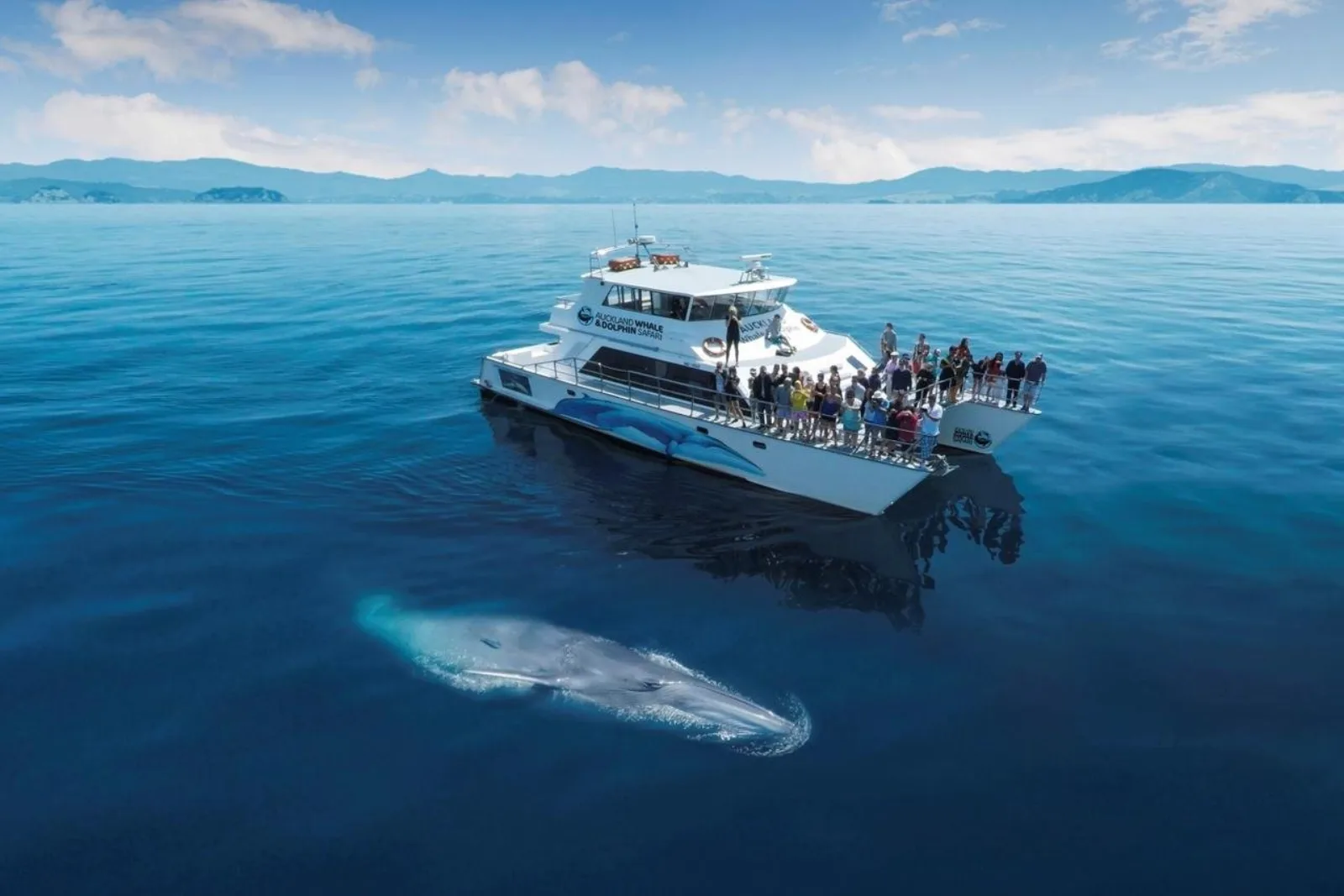
Auckland Whale and Dolphin Safari Eco Cruise
The most-reviewed wildlife cruise on this site: 4.5 hours on a 65-foot catamaran searching the Hauraki Gulf Marine Park for whales and dolphins, with a free second trip if no marine mammals are seen.
 BUFFET DINNER
Auckland Harbour Dinner Cruise with Buffet Dinner
The Red Boats' evening dining cruise: two and a half hours on the Waitematā with a seasonal buffet dinner and live commentary as the city lights come on. It is the longest of the operator's harbour loops on this site.
 90-MINUTE SAIL
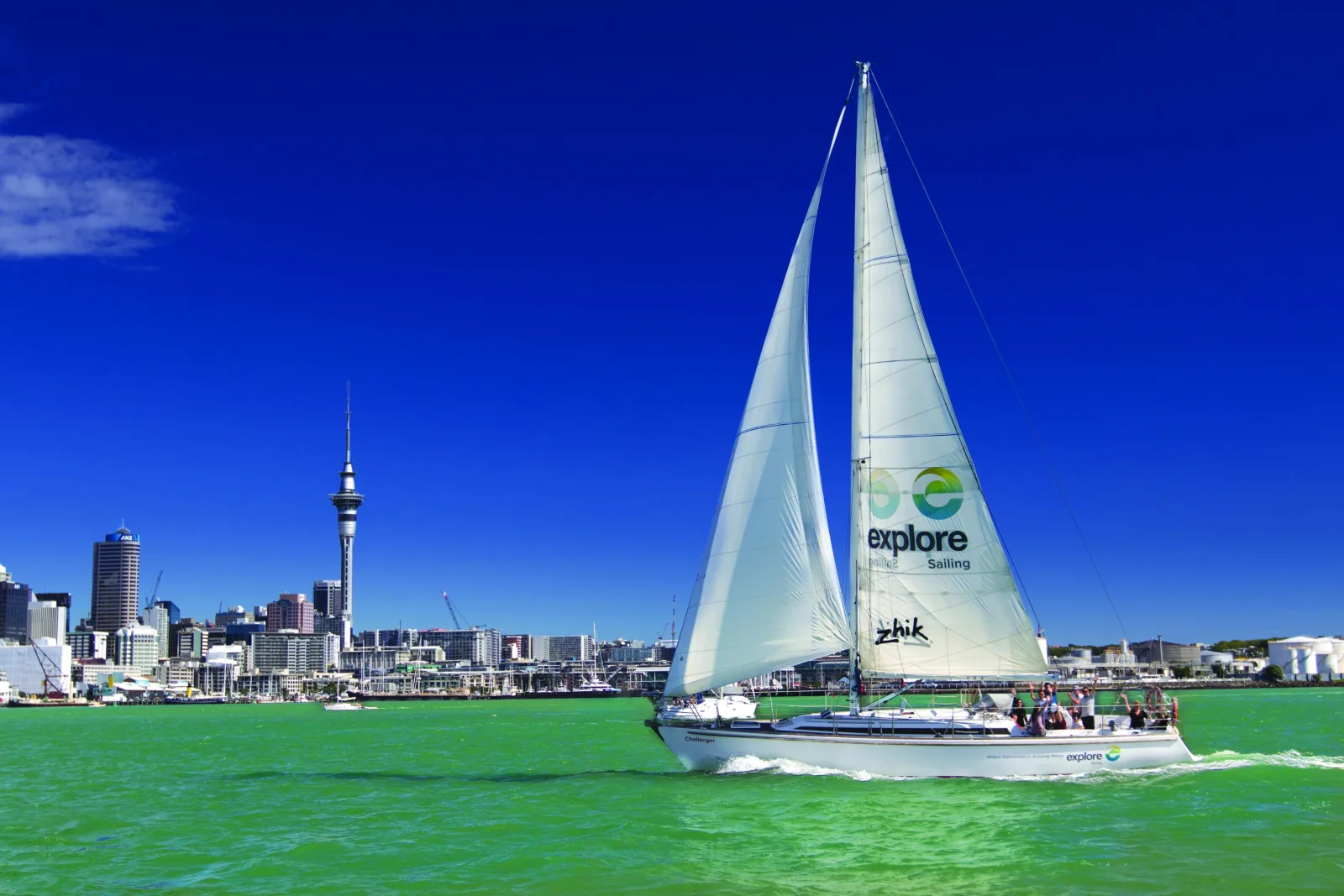
Auckland Harbour Sailing Cruise (90 Minutes)
A relaxed 90-minute sail on a 50-foot cruising yacht past the Sky Tower, Harbour Bridge, Westhaven Marina and Devonport, with a hot drink and the option to take the wheel.
 SUNSET
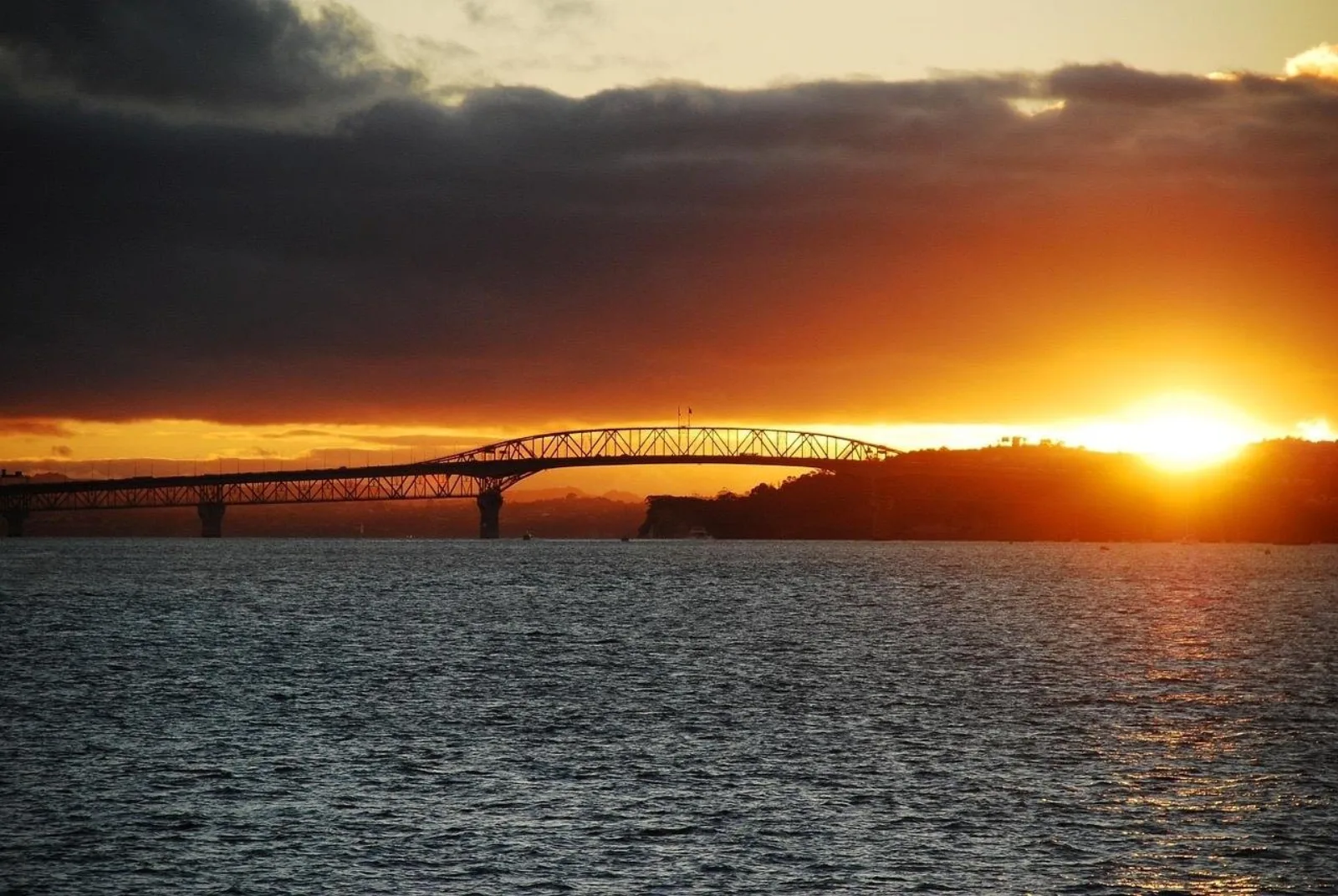
Auckland Sunset Harbour Cruise
A two-hour Red Boats evening cruise timed for golden hour, with live commentary, a slow pass by Rangitoto and a sunset photo stop at the Harbour Bridge. No food or drinks are included, and The Red Boats do not allow BYO food or alcohol, but the onboard bar sells drinks and light snacks.
 JET BOAT
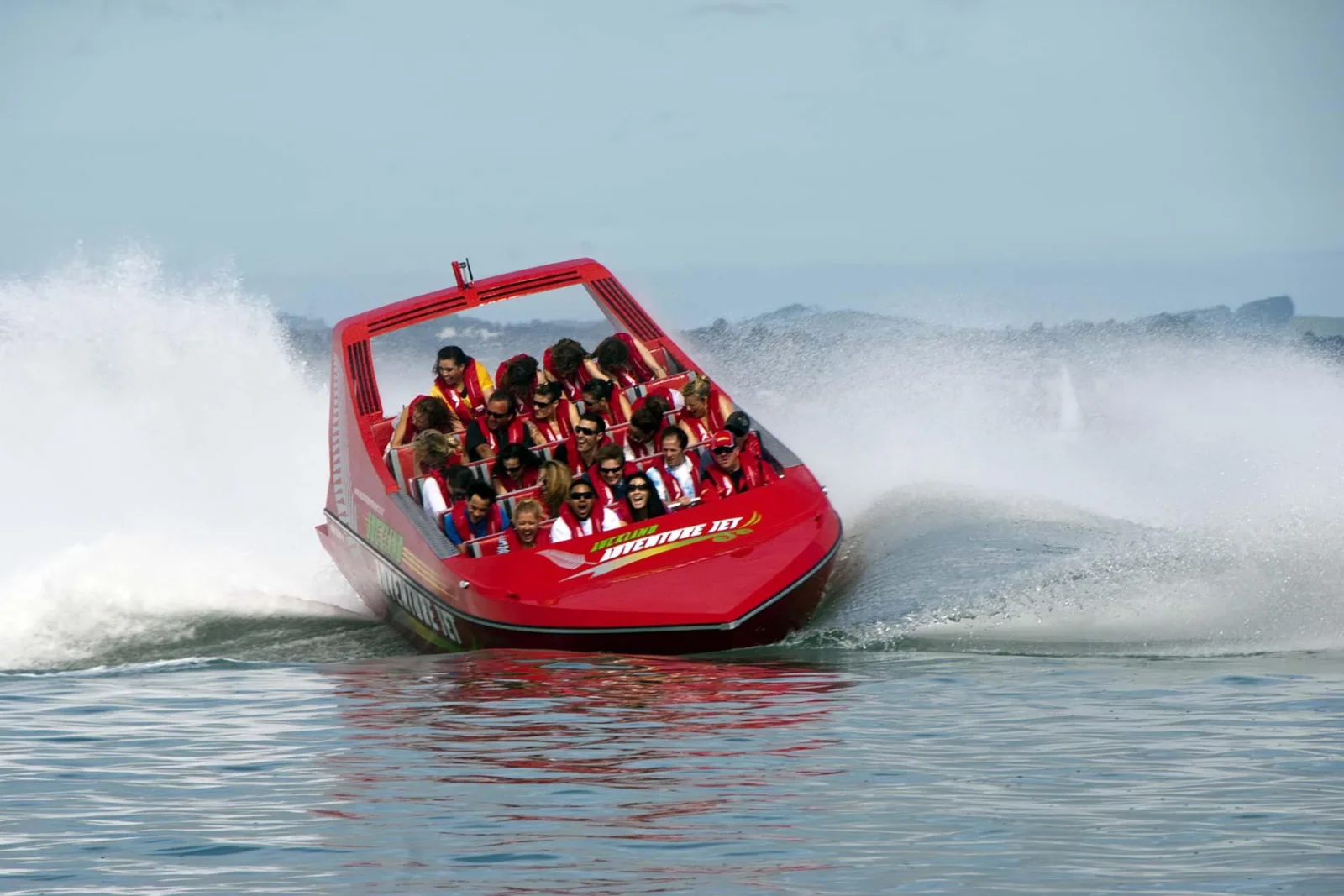
Auckland Harbour Jet Boat Ride
A 35-minute jet boat ride out of Westhaven Marina with high-speed spins and drifts near the Harbour Bridge, plus a pause for skyline views of the Sky Tower and Rangitoto.
 WAIHEKE FERRY
Waiheke Island Return Fast Ferry from Auckland
A return Fullers fast-ferry ticket between downtown Auckland and Waiheke Island, about 40 minutes each way with sailings every 30 to 60 minutes. It is transport only: tastings, tours and island buses are extra.
Whales and Dolphins
Choosing a Whale Watching Cruise in Auckland
What lives in the Gulf, the two boats that go looking, and how to pick.
You can walk from a hotel in central Auckland to Viaduct Harbour, board a boat and be looking for whales and dolphins in the Hauraki Gulf, Tīkapa Moana, the same morning. The Gulf opens out beyond the end of the harbour, and whales and dolphins live in it all year, so whale and dolphin watching here runs in every month instead of following one short migration season.
Two trips on this site go looking for them from the Viaduct. The Auckland Whale and Dolphin Safari is a 4.5-hour eco cruise from $124 per person that spends the whole trip on the wildlife. Explore Group’s Tīkapa Moana cruise costs NZ$210 per adult, booked direct with Explore, and runs most of the day, mixing a wildlife search with time ashore on an island. Both offer another trip if you see no marine mammals at all, and neither can promise any particular animal, because these are wild creatures in open water.
Auckland whale watching at a glance
| Question | Short answer |
|---|---|
| Where do the trips leave from? | Viaduct Harbour, central Auckland |
| Where do they go? | Out into the Hauraki Gulf, Tīkapa Moana |
| Dolphin you are most likely to see | Common dolphin |
| Whale you are most likely to see | Bryde’s whale |
| Can you see whales year-round? | Yes, Bryde’s whales live in the Gulf all year |
| Is there a whale season? | No single season; the trips run all year |
| How long are you out? | 4.5 hours on the safari, 5 hours 50 minutes to about 8 hours on the islands cruise |
| Are sightings guaranteed? | No. Both trips give you another go if no marine mammals are seen |
| Good for children? | Yes, if they can manage a long trip with quiet spells |
| The main drawback | It takes half a day or more, and the open Gulf can be rougher than the inner harbour |
The half-day safari
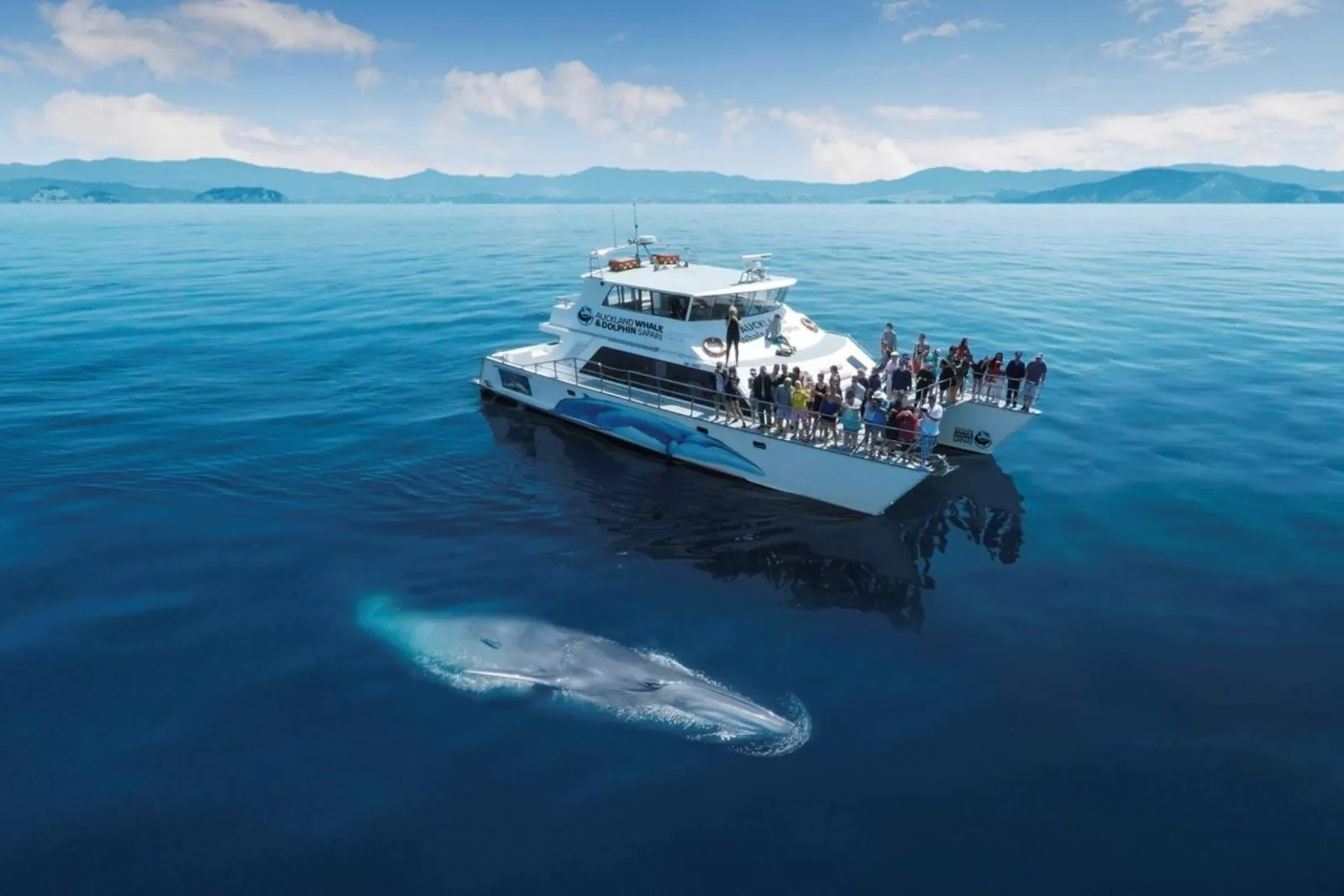
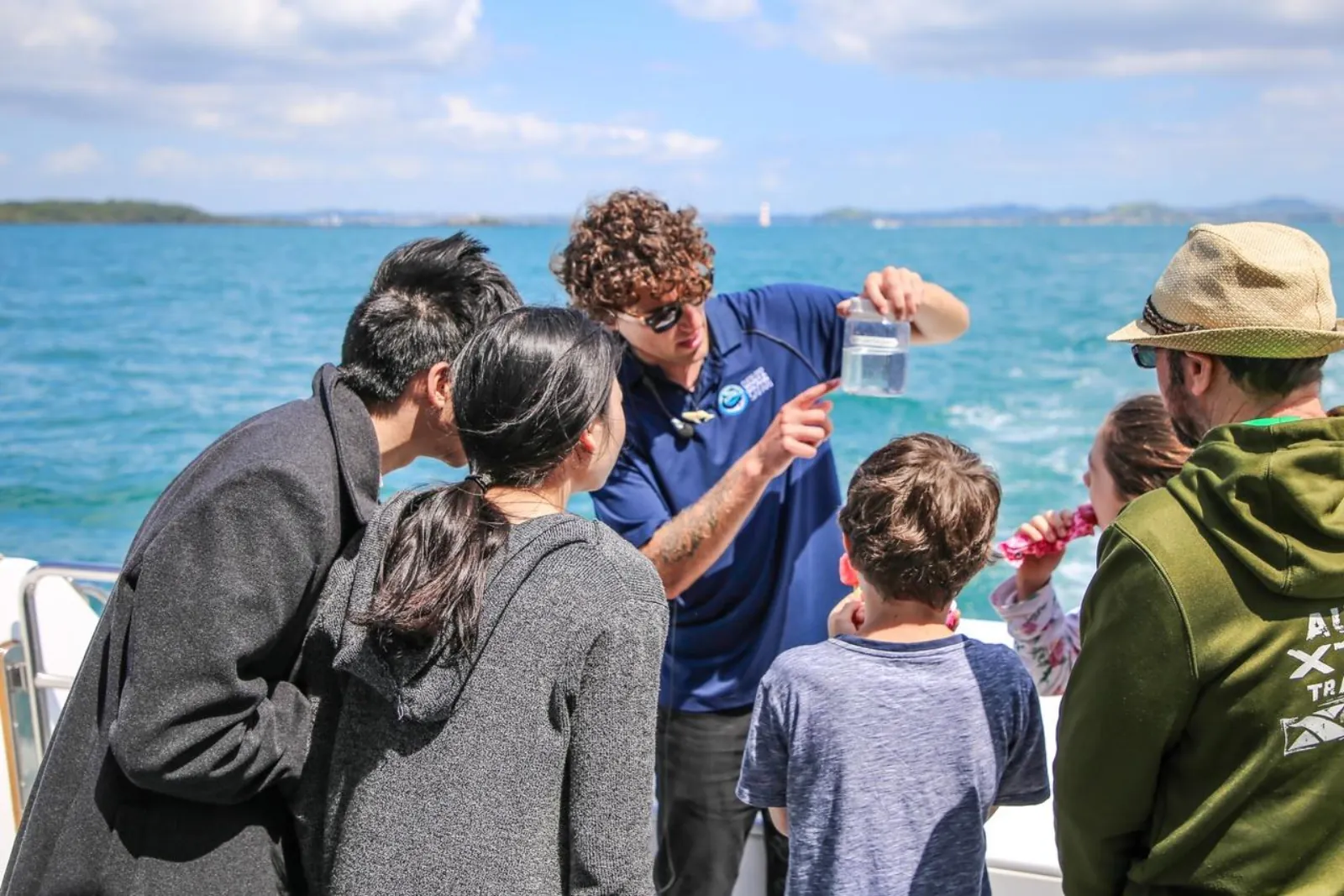
Our pick is the Auckland Whale and Dolphin Safari Eco Cruise (our breakdown). It is rated 4.5 from more than 1,250 reviews, which makes it the most reviewed cruise on this site. You board the Dolphin Explorer, a 20-metre (65 ft) catamaran berthed at Berth 9 in the Eastern Viaduct Marina, and head out past North Head, Devonport and Rangitoto before the search begins in the marine park. The skipper gives commentary on what you are seeing, and the operator’s marine science staff run small research activities that passengers can join.
This is the more focused of the two trips. It does not stop at any island, and the time goes on finding marine mammals, watching what they do, and the seabirds and fish that bring them to the surface. A typical safari meets common dolphins and Bryde’s whales, although every departure is different.
The trip lasts about 4.5 hours, around four of them on the water, which is long enough to get well beyond the Waitematā Harbour and search the Gulf without using up your whole day. The operator says it occasionally runs 15 to 30 minutes over when the crew finds something on the way home, so tell the skipper when you board if you must be back on time. From 1 April to 30 November there is one departure a day, at 10:30am, back at about 3pm. From 1 December to 31 March there are two, at 7:30am and 1:00pm. The boat sails every day except Christmas Day, and the operator says it does sell out at times, especially over summer.
Snacks, hot food and drinks, including beer and wine, are sold on board, and a dollar from every ticket goes to the Hauraki Gulf Guardians fund. If you see no marine mammals at all, the operator gives you and your party a complimentary voucher to come out again free. The voucher never expires, but it is not transferable or refundable, and you travel on it on a standby basis. It only helps if you have another day in Auckland, so do not book the safari for the afternoon before your flight home and count on the guarantee to cover a quiet day. The operator can cancel for wind, weather or sea conditions, and you then choose between another date and a refund.
A few practical limits apply. The operator says people in light wheelchairs who have some mobility can generally be taken on board, as long as the chair is no more than 67 cm wide. Passengers have to manage two stairs in the boarding area, with a carer’s help if needed, the indoor area and toilets have 15 cm door sills, and not every deck is reachable. Heavy or motorised wheelchairs cannot be lifted on board. The trip may not suit late pregnancy, and children under five can come only if a parent or guardian supervises them closely.
The islands cruise
The Tīkapa Moana Whales, Dolphins and Islands Cruise is a longer, looser day for NZ$210 per adult, booked direct with Explore Group (it is no longer sold on GetYourGuide). Explore Group runs it from its booking kiosk in Viaduct Harbour in partnership with Ngāi Tai Te Haeranga, on a purpose-built wildlife-viewing vessel. The commentary covers the history of Ngāi Tai ki Tāmaki, the conservation work on the islands and the volcanic peaks of the Gulf, as well as the wildlife.
Think of it as a day out on the Hauraki Gulf with whale and dolphin watching built in, more than four hours spent looking for whales. Part of the day is spent on an island: you choose Rotoroa Island or Man O’ War on Waiheke when you book, with time to walk, swim in a sheltered bay or visit the vineyard. That makes it a good fit if you only have a couple of days in Auckland and would otherwise book a separate island trip.
The schedule changes with the season. On the summer timetable, which starts at Labour Weekend in late October, the boat sails every day. On weekdays the 9:15am boat searches for wildlife first and stops at the island afterwards, returning at about 5:35pm Monday to Thursday and 4:35pm on Fridays. At weekends and on public holidays the 9:15am boat does the island first, and an 11:30am departure is a wildlife search with no island stop; both are back at about 5:20pm. In the cooler months Explore runs a reduced timetable: in 2026 that was Wednesday to Sunday only, at 9:15am, back at about 4pm. The same ticket name therefore covers different days, so check the timetable and what your departure includes for your date before you book. Explore lists the trip at 5 hours 50 minutes to 8 hours. The boat also works the island ferry runs, so it may pick up and drop off other passengers along the way.
The guarantee here is a return voucher if no marine mammals are sighted, valid for 12 months from your travel date and subject to availability. Food and drinks are sold on board. Its rating is lower than the safari’s, and the day divides its time between wildlife and an island, so it suits people who want both, families who would find a straight wildlife trip too long, and travellers who enjoy the scenery as much as the animals.
Which cruise to book
For a trip that is all about the animals, book the safari. It is the dedicated wildlife cruise, it is shorter, and the free repeat trip is simple to use if you are still in Auckland for a few days. If you would like a swim, a walk or a glass of wine on an island as part of the day, and a lower price, take the Tīkapa Moana cruise. Its island stop can also save you booking a second trip out to the Gulf.
| Whale and Dolphin Safari | Tīkapa Moana cruise | |
|---|---|---|
| Main focus | Wildlife | Wildlife, the Gulf and an island |
| Time out | About 4.5 hours | 5 hours 50 minutes to about 8 hours, by departure |
| Leaves from | Berth 9, Eastern Viaduct | Explore kiosk, Viaduct Harbour |
| Whale and dolphin search | Yes | Yes |
| On board | Marine science staff and research activities | Commentary on the Gulf’s history and conservation |
| Island stop | None | Rotoroa or Man O’ War, except the 11:30am weekend sailing |
| If no marine mammals are seen | A free voucher for another trip, no expiry, standby | A return voucher, valid 12 months, subject to availability |
| Price | From $124 on GetYourGuide | NZ$210 per adult, booked direct |
Prices on this site are GetYourGuide’s, in US dollars. Booked direct, the operators quote New Zealand dollars: the safari lists NZ$225 per adult and NZ$155 per child aged 0 to 14, and Explore lists the Tīkapa Moana cruise at NZ$210 per adult and NZ$105 per child aged 5 to 15, with under-fives free.
What lives in the Gulf
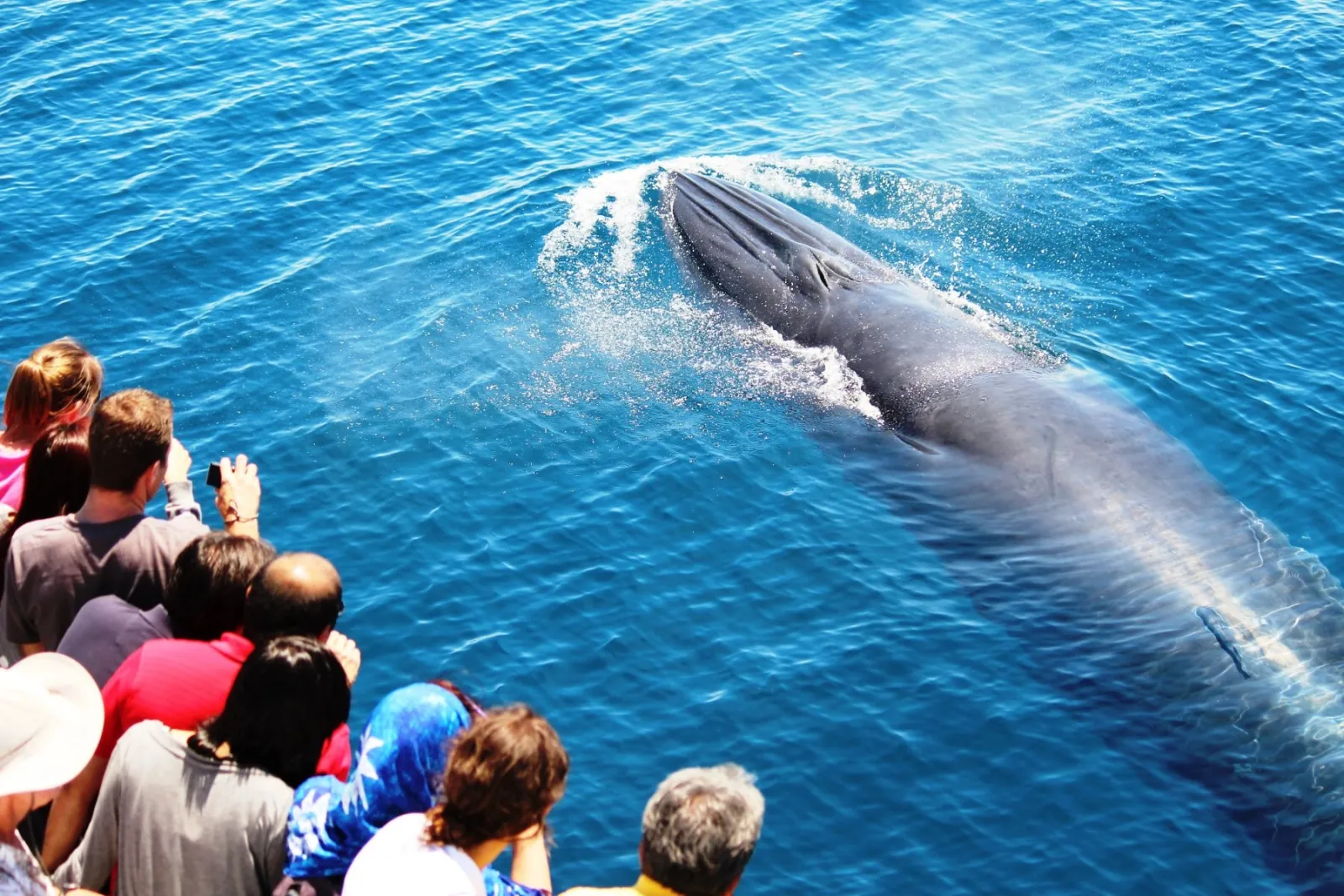
The whale you are most likely to meet is the Bryde’s whale. About 140 of them use the Hauraki Gulf, and a core group of around 50 stays mostly inside it all year instead of migrating. They are classed as Nationally Critical in New Zealand, and the wider northern population is thought to number under 200. Ships are the main threat, and voluntary speed limits of around 10 knots have applied in the Gulf since 2013.
Common dolphins are the animals seen most often, in every season. Orca, bottlenose dolphins, and sei and minke whales turn up regularly, and humpbacks pass through on their migrations. Seabirds are part of every trip. The whole area has been a marine park since 2000, when the Hauraki Gulf Marine Park became New Zealand’s first.
Bryde’s whales
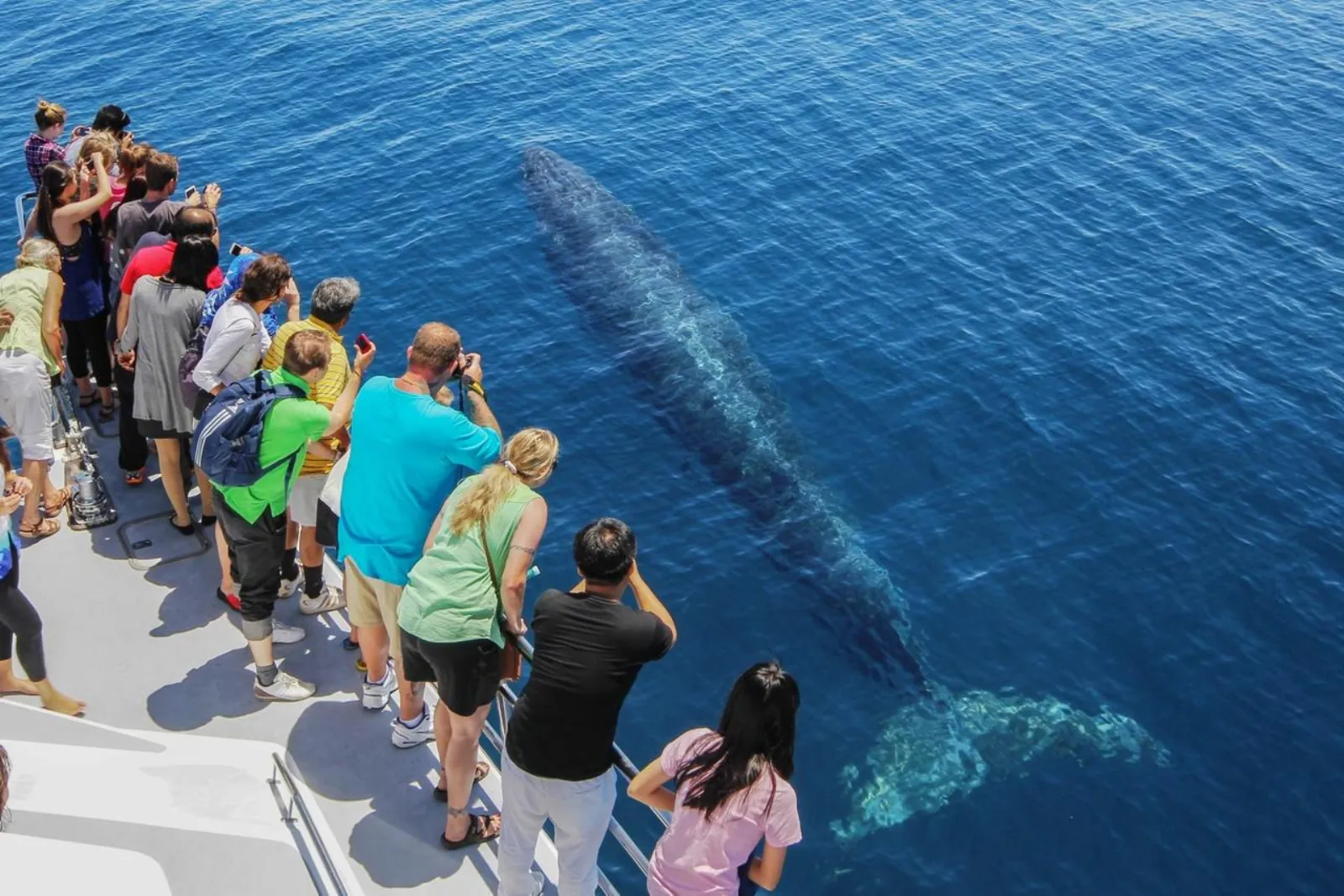
Bryde’s whales grow to as much as 15 metres. They are baleen whales: instead of teeth they have rows of baleen plates that strain food from the water, and in the Gulf they eat both krill and other zooplankton and small schooling fish such as anchovies and pilchards. They feed in daylight and spend much of their time close to the surface, which is part of why they are the whale seen most often here.
From the boat you are looking for a long, dark back, a small hooked dorsal fin and a blow, often several breaths before a longer dive. Bryde’s whales do not lift their tail flukes when they dive, so if you are picturing the classic whale-tail photograph, this is not that kind of whale. An Auckland encounter is more often about a whale feeding or surfacing near the boat.
Look for the birds first
The action often starts with birds. Australasian gannets gather over a school of fish and dive into it from height, and below them you may find the fish driven up to the surface, common dolphins feeding, and sometimes a Bryde’s whale. New Zealand fishers call these feeding frenzies work-ups. Researchers in the Gulf have recorded gannets, shearwaters and Bryde’s whales joining feeding common dolphins, with whales following a foraging dolphin group for up to an hour and a half. If the crew suddenly turns towards a big flock of diving seabirds, that is usually why.
Humpbacks and the rarer whales
You can see humpback whales from Auckland, but they only pass through on migration and are an occasional sight. Over its years on the Gulf, the safari’s operator has also met blue, fin, sei and southern right whales alongside the Bryde’s whales it sees most often. Treat any of them as a bonus.
Orca
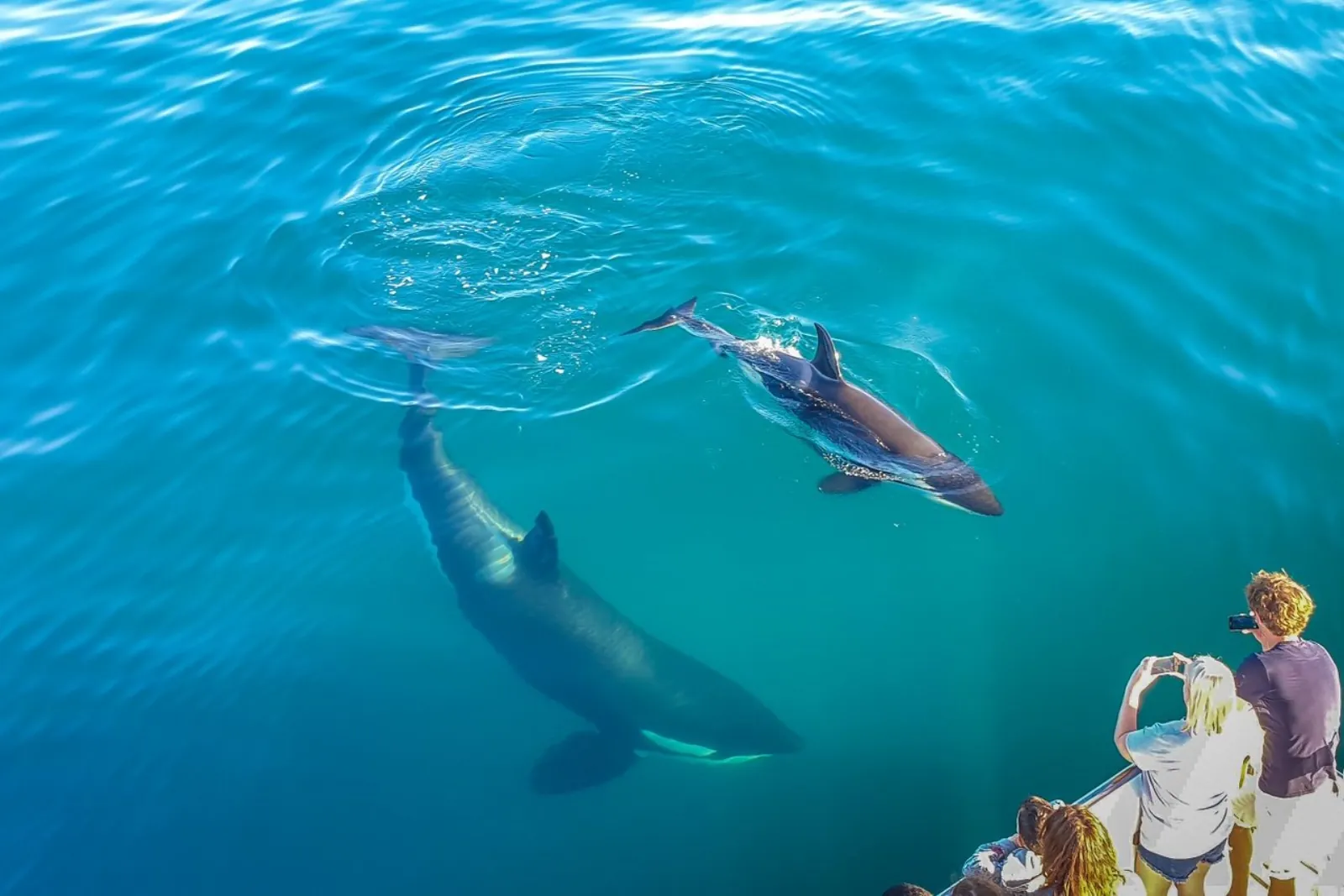
Orca are seen in the Gulf, and the operator says they pass through in every month, so one could turn up on any trip. They are not something you can plan for, though: the operator estimates there are fewer than 200 around the whole New Zealand coast. Orca are the largest members of the dolphin family, and a day with them on it is an unusually lucky one.
Common dolphins
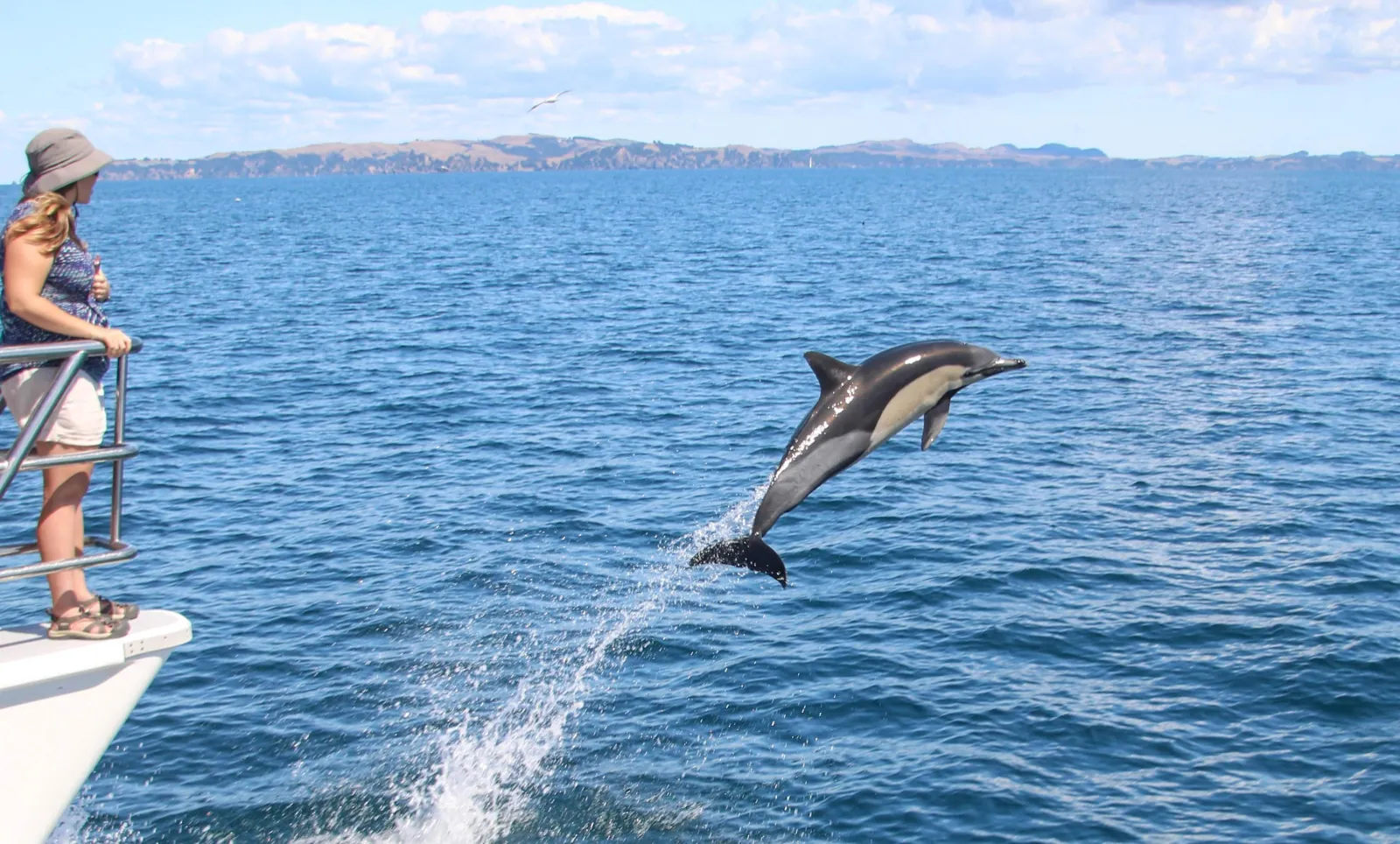
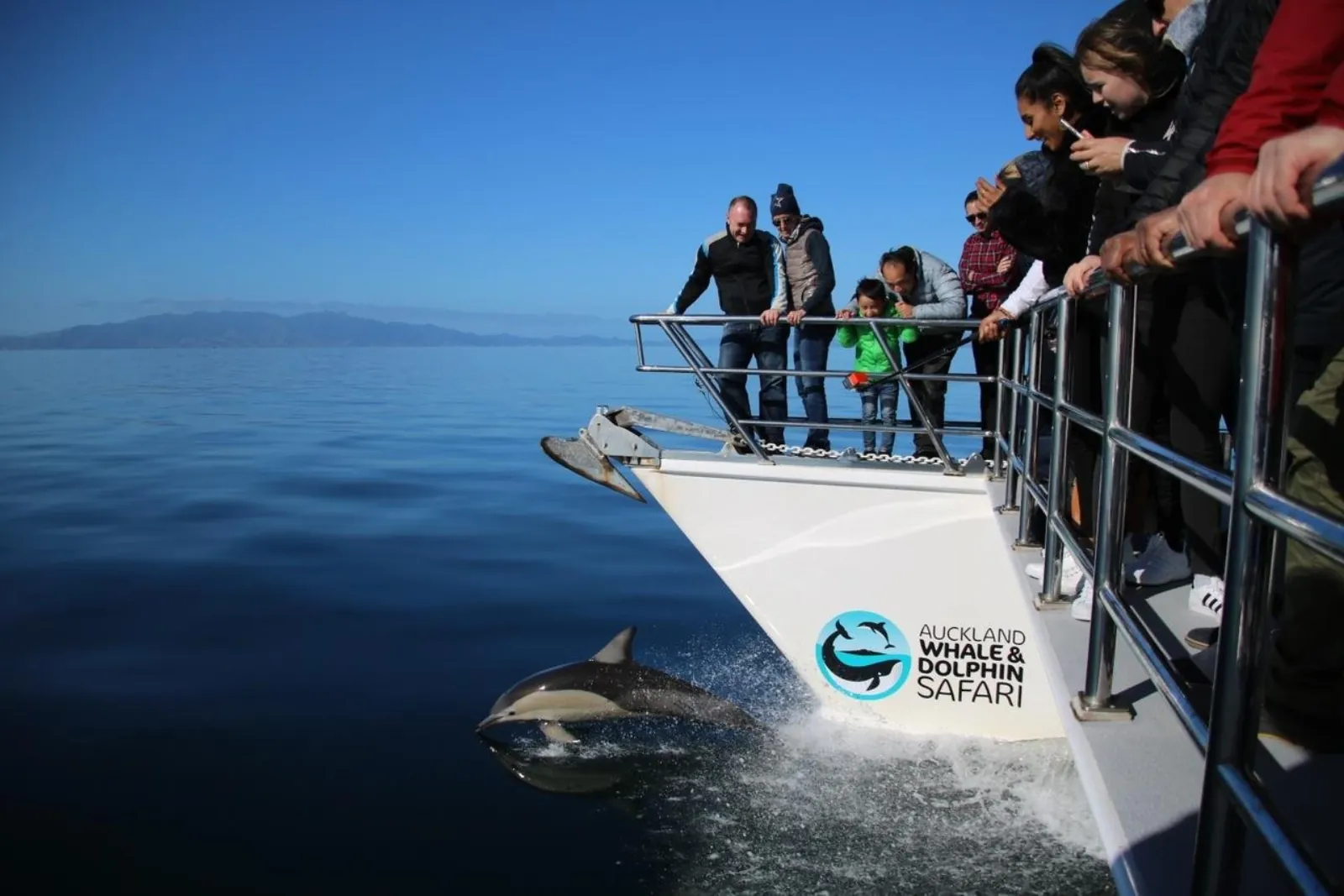
Common dolphins are the main event on most Auckland trips. The Department of Conservation names the Hauraki Gulf and Northland as New Zealand’s hotspots for the short-beaked common dolphin, and the safari’s operator says it sees dolphins on more than 90% of its trips. They are fast and social, and you may see them riding the bow wave, leaping, travelling in a pod, feeding or racing alongside the boat.
There is no normal number to expect. A pod can be a handful of animals beside the boat, and common dolphins can also form schools of several thousand. Both operators say the large pods are more likely in the cooler months.
Bottlenose dolphins
Bottlenose dolphins also live around Auckland, but you see them less predictably than common dolphins. They are bigger and heavier, up to about 3.9 metres, with the short beak most people picture when they think of a dolphin. They are classed as Threatened – Nationally Vulnerable in New Zealand’s 2024 marine mammal assessment, and a sighting is a bonus.
Seals, penguins and other sea life
The trip is not only about two animals. New Zealand fur seals, little penguins (kororā), sharks and rays are all possible, and in summer the safari’s operator sometimes sees warm-water visitors such as turtles and manta rays.
Seabirds
Do not ignore the birds while you wait for a whale. The Gulf is one of the most important seabird areas in the country: the operator counts 24 species breeding in or near the marine park, and four, including Buller’s shearwater and the black petrel, breed nowhere else in the world. The ones you see most often from the boat are Australasian gannets, shearwaters, terns, petrels and little penguins. Birds, fish, dolphins and whales are all tied together by the same food, which is what makes a day out here more than a list of sightings.
Are whale sightings guaranteed?
No. Auckland’s whales and dolphins are not captive, fed or trained, and the crews are searching for wild animals across a very large stretch of sea. You might see whales and dolphins, dolphins and no whale, a whale with little dolphin activity, several species, or occasionally no marine mammals at all.
Both operators soften that risk with a repeat trip, but read what the guarantee covers. It is a marine mammal guarantee, not a whale guarantee: if you see dolphins and no whale, the trip counts as a success and no voucher is due.
How good are the chances of seeing dolphins?
Good. The safari’s operator says it sees dolphins on more than 90% of its trips, and that fewer than 5% of its passengers see neither whales nor dolphins. That is a record across many trips. It cannot promise anything for yours, because the animals move from day to day.
How good are the chances of seeing a whale?
Lower than for dolphins, and less predictable. Resident Bryde’s whales mean there is a real chance in any month, but on the day a whale may be travelling, feeding, down on a dive of several minutes, or outside the area the boat can search. That is why both trips are sold as whale and dolphin watching.
When to go
There is no short whale-watching season in Auckland. Bryde’s whales and common dolphins live in the Gulf all year and both trips run in every month, which sets Auckland apart from places where whale watching follows a brief annual migration. The season changes three things: how comfortable you are on deck, how long the day is, and the timetable.
Summer, December to February, is the warm option, with highs of about 22 to 26°C and the longest days. Warmer weather does not mean more whales; you are choosing summer for comfort, and for the safari’s summer timetable of 7:30am and 1:00pm sailings. Autumn, March to May, cools gradually and still has the same resident whales and dolphins, which makes it easy to fit into a wider New Zealand trip.
Winter, June to August, is the season people tend to dismiss, and it has a real draw: both operators say the very large dolphin pods are more likely in the cooler months. The cost is the cold, with highs of about 12 to 17°C on land and less out on the water, so dress for it. Spring, September to November, brings longer days but also the windiest weather of the year, especially in October, so bring more layers than the city forecast suggests. Our guide to the best time for whale watching in Auckland goes month by month, with morning and afternoon sailings and how to plan around the weather.
Morning or afternoon?
No reliable rule says whales appear at 8am and vanish by lunchtime. Marine mammals follow their prey, the tides and the currents, so choose your departure for practical reasons. For much of the year there is little choice to make anyway: from April to November the safari has a single 10:30am sailing, and from December to March you choose between 7:30am and 1:00pm. The Tīkapa Moana cruise leaves at 9:15am, with an 11:30am wildlife-only sailing at weekends and on public holidays on its summer timetable.
Where you do have a choice, an earlier departure leaves the rest of the afternoon free and keeps you out of the hottest part of a summer day. A later one suits you if you dislike early starts or want to see something else in the city first. Neither gives you better wildlife.
How far the boats go
These are not short Waitematā Harbour sightseeing cruises. The boats leave the inner harbour and head out into the Hauraki Gulf, Tīkapa Moana, to wherever the wildlife is feeding or travelling, so you get far more open water than on a cruise under the Harbour Bridge. The safari’s search area covers most of the marine park, out past Kawau Island and towards Little Barrier Island, and the route changes every day because the animals move. On the way you can expect Devonport, Rangitoto and the other volcanic islands, and on a clear day the Coromandel in the distance.
A harbour cruise or a Gulf trip?
A harbour cruise usually stays around the city, the Harbour Bridge, Devonport and Westhaven, lasts one to two hours and is a sightseeing trip. A whale and dolphin trip goes much further, lasts 4.5 hours or more and is a wildlife trip, closer to a half-day marine safari than to a harbour cruise.
Book a harbour cruise if you have an hour or two, the skyline and the bridge are what you want to see, and you would prefer calmer water. The 90-minute Auckland Harbour Sightseeing Cruise with Live Commentary and the Auckland Harbour Sailing Cruise (90 Minutes) are the usual choices. Book whale watching if wildlife matters more, you have at least half a day, and you do not mind open water and a route nobody can fix in advance. Our harbour cruise or ferry guide and our guide to which Auckland harbour cruise is right for you cover the shorter trips.
On board
The boat
Both trips use larger purpose-built boats instead of small speedboats, which matters when you are spending several hours offshore. On the safari’s Dolphin Explorer you get open outdoor viewing decks, a limited amount of indoor seating, two toilets and a licensed café, with room for up to 100 passengers. Most people sit outside, where you can get wet, so bring a showerproof jacket; the only indoor seating with a decent view of the wildlife is upstairs. A catamaran also gives you room to cross to the other side when an animal surfaces there. The Tīkapa Moana boat has cabin seating, toilets and a licensed café, and passengers need to be able to manage stairs to board.
Where to stand
Do not get attached to one seat, because the whales do not know which side of the boat you are on. When something appears, listen to the crew, move calmly, keep the narrow walkways clear and leave room at the rail for children and shorter passengers. An upper open deck is good for spotting animals further off, and the lower side decks are the place to be when dolphins start riding the bow.
Can you swim with the dolphins?
No. Both are viewing trips. Swimming is not allowed at any point on the safari, and the only swim on the Tīkapa Moana cruise is at the island stop, away from the wildlife. If you came across these trips while looking for a dolphin swim, they are not that.
How close will you get?
That depends mostly on the animal. Every commercial whale and dolphin trip in New Zealand needs a permit from the Department of Conservation, and both of these operators hold one. The Department’s rules for boats ask them to stay at least 50 metres from any whale and 200 metres from a baleen or sperm whale mother with her calf, to slow to idle within 300 metres, and to keep no more than three vessels that close. Dolphins, though, often choose to come in on their own, riding the bow, swimming alongside or crossing under the boat. At other times you watch from further away. A good encounter is measured more by what the animals are doing than by how many metres away they are.
Is Auckland whale watching ethical?
It can be, if you choose a responsible, permitted operator. All marine mammals in New Zealand are protected under the Marine Mammals Protection Act 1978, which makes it an offence to harass or disturb them, and the Marine Mammals Protection Regulations 1992 set out how boats behave around them. The signs of a responsible trip are easy to spot from the deck: no chasing, no feeding, slow and careful approaches, limited time with each animal, a crew that explains what the animals are doing, and a link to conservation or research. The safari’s operator is also certified by the World Cetacean Alliance as a responsible whale-watching operator.
The research on board
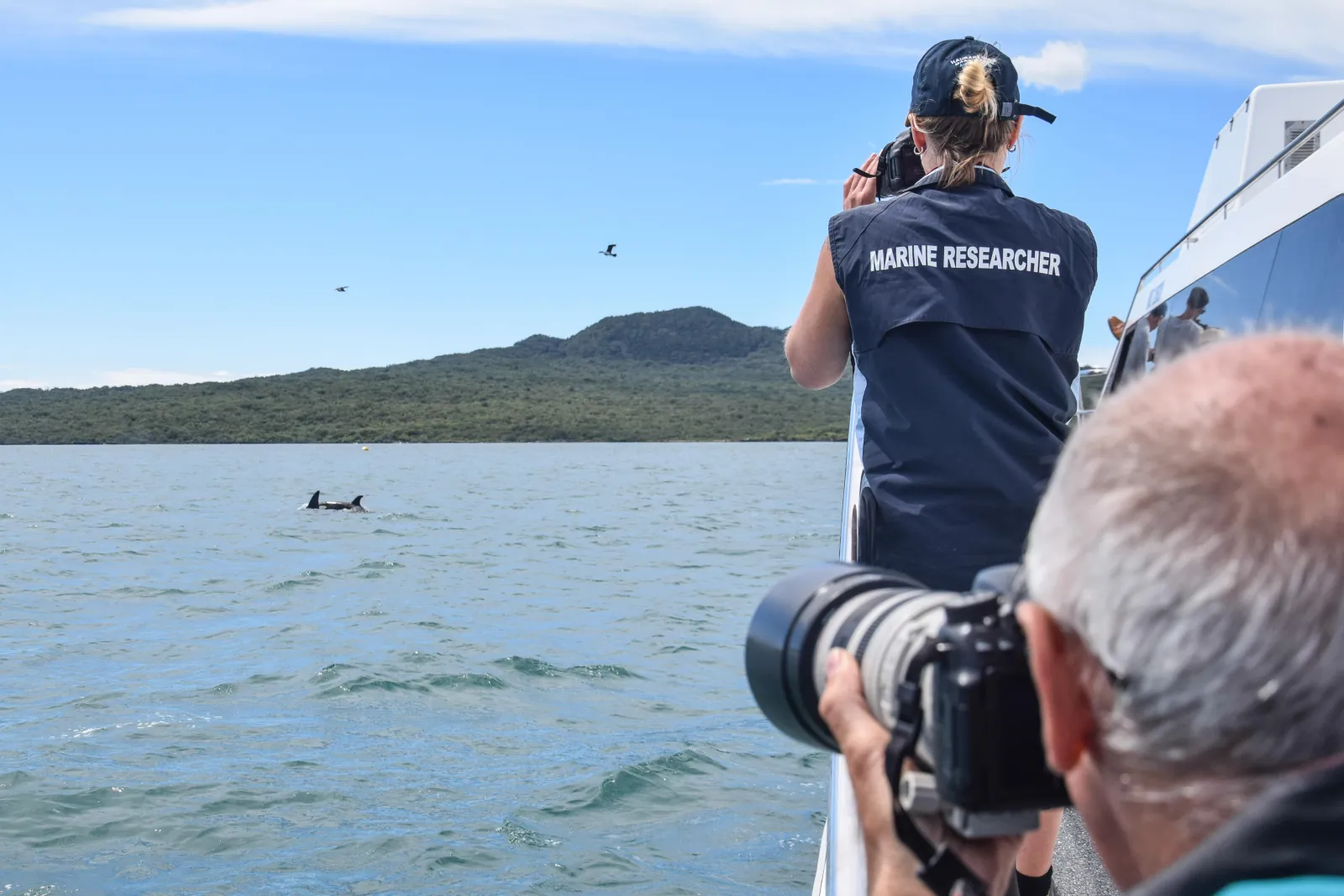
The research is a genuine part of the safari. The Dolphin Explorer has carried researchers from the University of Auckland’s Marine Mammal Ecology Group for the whole of the company’s history, and helped collect data for the first estimate of how many Bryde’s whales use the Gulf. Massey University’s Cetacean Ecology Research Group also uses the boat, and its work includes the first estimate of common dolphin numbers in the Gulf. On board, passengers can join citizen-science projects that record water clarity and colour. That gives a curious traveller something to do during the quiet spells, when nothing is in sight.
Is Auckland whale watching worth it?
Yes, if wildlife matters to you. The draw is the combination: resident whales, common dolphins and a large marine park, with the boat a short walk from the city-centre hotels. You can have breakfast near the Sky Tower and be searching for whales later that morning.
It is a particularly good use of a day if you have never seen whales in the wild, love dolphins, are interested in nature, marine conservation or photography, are travelling with older children, have at least two full days in Auckland, and want something beyond city sightseeing.
You might skip it if you only have one afternoon in Auckland, you get badly seasick, the forecast for your whole stay is rough, you have already booked whale watching elsewhere in New Zealand, or the skyline is all you are after. For that last one, book a 90-minute harbour cruise instead.
Auckland or Kaikōura?
Visitors often compare the two, but they are not the same trip. Auckland is about Bryde’s whales, common dolphins and the Hauraki Gulf, with year-round wildlife and a departure from the city centre that slots into a city break. Kaikōura, on the east coast of the South Island, is best known for sperm whales in deep water with mountains behind them, and it ranks among New Zealand’s best-known whale-watching places. If your trip includes both and you love wildlife, you could reasonably do both.
Auckland or the Bay of Islands?
Auckland’s advantage is convenience: you leave from the middle of a major city instead of travelling north for a separate trip, and the Gulf gives you the chance of common dolphins, Bryde’s whales and seabirds on the same day. If your itinerary already includes the Bay of Islands, though, you may decide one wildlife cruise is enough.
Sea conditions and seasickness
Both boats leave the sheltered inner harbour for the open Gulf, and on a windy day you will feel the swell more than on a harbour cruise. Conditions range from very calm to quite lively, and spring, October in particular, tends to be the windiest time of year. It is always cooler out on the water than in town, even in summer.
If you are prone to motion sickness, take it seriously, because you are aboard for 4.5 hours or longer. The safari’s operator recommends taking seasickness medication at least an hour before boarding; it does not sell medicine on board, though it does sell Sea-Bands, ginger tablets and ginger beer. Other things that help: eat a light meal beforehand, stay outside in the fresh air, watch the horizon, avoid reading or staring at your phone, and stand near the middle of the boat, where the movement can feel less. Follow the instructions for any medication you take.
If the trip is cancelled
Either operator can cancel or change a trip for strong wind, a rough sea or unsafe weather. On open water a cancellation usually means the skipper is being sensible. The safari’s operator contacts passengers before 10am on the day and posts updates on its trip status page, but it is up to you to check that your trip is running. If your trip is cancelled, you can move to another date or take a refund. Keep your plans flexible if you can, and do not leave whale watching until your last few hours in Auckland.
Whale watching with children
These trips can be very good for families, because unpredictable wildlife tends to hold a child’s attention better than another sightseeing tour. On the safari, anyone under 18 must be with an adult and supervised throughout, child life jackets are available and can be worn for the whole trip on request, and there is no free fare for infants: every child from birth to 14 pays the child price. Explore charges the child fare for ages 5 to 15 on the Tīkapa Moana cruise and lets under-fives travel free.
Whether 4.5 hours is too long depends more on the child than on the cruise. Wildlife trips have quiet spells, sometimes long ones, before anything happens. For young children, bring snacks, water, warm clothes, sunscreen and something quiet to do, and do not promise a five-year-old four hours of dolphins jumping beside the boat.
What to wear and bring
Dress warmer than you would for walking around central Auckland. Even on a sunny summer day the wind on open water makes the deck feel cooler than the city, and in winter you need proper warm layers. The safari’s operator asks for flat-soled shoes and will ask anyone in heels to take them off; Explore asks for flat shoes too.
A sensible list:
- a warm layer, plus a windproof, showerproof jacket
- comfortable trousers or shorts and flat, closed shoes
- a sun hat (or a warm hat in winter), sunglasses and sunscreen
- your phone or camera, with a charged battery
- a reusable water bottle (the safari refills it free)
- seasickness medication, if you need it, and any personal medication
- small binoculars, if you own a pair
- a card for food and drinks on board
- swimwear and a towel if you are taking the Tīkapa Moana cruise with an island stop
Leave the heavy camera kit at home unless wildlife photography is a serious hobby, because you will be moving around the boat. Before you board, check your bags and shoes for soil, seeds and pests, since both boats visit or pass pest-free islands.
Food on board
Food is not included on either trip. The safari’s café sells toasted sandwiches, sausage rolls, muffins and drinks, including beer and wine, and you can bring your own food and non-alcoholic drinks. On the Tīkapa Moana cruise lunch is not included, but sandwiches, snacks and drinks are sold on board. Plan the island stop too: Rotoroa has no food for sale and no rubbish bins, so take your own food and your rubbish home, while Man O’ War has a beachfront tasting room and restaurant, where Explore recommends booking ahead. For the safari, eat beforehand and carry water.
Photography tips
Start a little wider than you think you need. If you zoom tight on one dolphin it can leap out of the frame before you press the shutter, and you can crop later. Use burst mode, because dolphins move fast and a burst gives you a much better chance of a full leap, a bow ride or several animals in one frame. Watch the birds too: a mass of diving gannets often marks a feeding event, so point the camera there before everyone else notices the whale.
On a proper camera, keep the shutter speed fast, since both the animal and the boat are moving; a fast shutter matters more than a low ISO. Photograph the behaviour, not just the body. A dorsal fin proves you saw a whale, but a blow, a feeding lunge, dolphins jumping, gannets diving, a whale with an island behind it or two species together make the better picture. Drones are not allowed on the safari, and nothing, including a GoPro, goes in the water.
Then put the camera down. A wild whale beside the boat is far more impressive in person than as the 73rd near-identical shot in your camera roll.
Getting to the boat
Where the boats leave from
The safari leaves from Berth 9, Eastern Viaduct Marina, Viaduct Harbour, at the western end of Quay Street. Arriving on foot, you will see the boat opposite the entrance to the New Zealand Maritime Museum, and you check in with the crew at the top of the boarding ramp.
The Tīkapa Moana cruise checks in at Explore’s booking kiosk in Viaduct Harbour, at the end of Quay Street and diagonally across from the New Zealand Maritime Museum. Both are an easy walk from the city centre.
How early to arrive
Aim to be at the Viaduct 20 to 30 minutes before departure. Both operators ask you to check in at least 15 minutes before sailing, and on the safari your seat can be released to standby passengers if you are late, with no refund. Give yourself longer if you are parking, do not know the Viaduct, are coming from outside the centre or are travelling at rush hour.
Do you need a car?
No. Not needing one is among the trip’s biggest advantages: no hire car, no transfer and no hour-long drive out of the city. From Britomart, Commercial Bay, Wynyard Quarter, central Queen Street or the Viaduct itself you can walk to the departure point, and the safari’s operator encourages passengers to come by bus, train or ferry. If you do drive, there are car parks around the city centre, and the operator suggests an open-air car park for a campervan.
Fitting it into your Auckland trip
With one day in Auckland, we would not spend most of it whale watching unless marine wildlife is your top priority. A morning in the city, a harbour cruise, the waterfront and a viewpoint such as Mount Eden make a fuller first day.
With two days it becomes much easier to recommend. Use half of one day for the safari and keep the rest for the city. With three days or more, we would definitely consider it: Auckland makes much more sense once you have been past the inner harbour and out into the Gulf.
Whale watching and Waiheke on the same day
We would avoid booking two separate trips on one day, because a wildlife search can run late and a missed connection spoils both. If you want both, the Tīkapa Moana cruise is the neat answer, since its island stop can be at Man O’ War on Waiheke. For a full day of Waiheke wineries, give the island its own day with the Waiheke Island Return Fast Ferry from Auckland, and see our ferry page for the options.
Whale watching and Rangitoto
The same goes for Rangitoto. You will see it close up from the wildlife boat, but that is not the same as climbing it: the summit track takes about an hour each way from the wharf, and the ferries run only a few times a day. If Rangitoto matters to you, give the whales one day and the Return Ferry to Rangitoto Island at least half of another.
Is it a cruise at all?
Technically, yes, but it makes a different kind of day from a relaxed sunset sail around the harbour. You travel further, you spend time searching, the boat goes where the wildlife is, and the route can change on the way. It is closer to a marine wildlife expedition on a comfortable passenger boat, which is exactly what makes it interesting.
Before you book
Run through these first:
- Length: 4.5 hours, or most of the day with an island stop?
- Focus: wildlife only, or wildlife and an island?
- Departure time: which sailings run on your date?
- Return time: does it clash with dinner or another tour?
- Guarantee: what exactly happens if no marine mammals are seen?
- Voucher: could you realistically use a repeat trip before you leave Auckland?
- Weather: what happens if the operator cancels?
- Food: what is sold on board, and what is on the island?
- Children: the age rules and fares for your trip
- Seasickness: take medication before you board if you need it
- Clothing: bring a windproof layer whatever the season
We would not choose a trip because it seems to promise one particular species. Wildlife does not keep a schedule, which is part of the appeal.
If birds interest you as much as whales, the Tiritiri Matangi Island Ferry (our breakdown) takes you to a pest-free island sanctuary for $59, and our ferry page covers it with the other island trips. To compare whale watching with the rest of what is on the water, see our guide to the best boat tours in Auckland, whether a harbour cruise is worth it, or the homepage. Ready to go? Check availability for the safari.
Guest Reviews
What Whale Watching Guests Say
4.5/5
from 1275 verified guests
Ratings and review counts are the tour operators' live figures on GetYourGuide and may shift slightly day to day.
"The activity was an amazing experience too much dolphins action along the day and towards near end point of the tour, my partner and myself spotted the whale splashing in the great distance and the cruise crew went great beyond to make sure everyone on the cruise could see the whale splashing and not be disappointed."
"My partner and I had such a great time on the experience! The crew were super friendly, informative and so knowledgeable! They gave amazing facts and presentations and when I felt seasick, I was given a ginger cube and bag - which I really appreciated. It was amazing being in the gulf, with the sun shining on the beautiful water! we got to see a lot of dolphins, which was so magical! I will never forget it. We didn’t see a whale but it doesn’t take anything away from it! It was a lovely time and glad we did it!"
"Excellent - very knowledgeable & experienced crew & guides. Love the fact that this activity supports marine research! Greatly enjoyed our time out of the boat - highly recommend. We managed to see two types of dolphins, whales (in the area) & a fur seal enjoying the sun!"
"The guides are very knowledgeable and friendly, and the boat was very clean. Sadly, we didn't get to see any Whales, but we did see Bottlenose Dolphins who came up to boat and play around us, which was amazing. We were invited back for a free tour because we didn't see any of the Whales and other Dolphins while we were at sea (Bottlenose Dolphins are excluded because they are endangered and can't be approached, they came to us - very lucky!). Can't fault the staff, would recommend the tour."
"We were fully aware that these are wild animals and sightings were not guaranteed. So, we were lucky to encounter multiple schools of dolphins swimming very close to our boat. The crew were knowledgeable and happy to share their expertise on marine mammals and birds. We particularly liked the tips and tricks that they shared on how to spot the animals. It reinforced the need for environmental conservation. The toilet onboard was clean too, recommend to use it and not hold your bladder. (:"
"Sad not to see any whales up close, saw their spouts, but were gone by the time we got to that point. Dolphins gave a great display swimming and leaping alongside the boat with calves. seeing Penguins was a bonus."
"Great experience. the crews are very professional and nice. Taking care of elders and kids. we enjoyed the journey a lot!"
Read all 1275 verified reviews
See All ReviewsHalf a Day in the Marine Park
A 4.5-hour eco cruise on a 65 ft catamaran from the Eastern Viaduct, past Devonport and Rangitoto and into the Hauraki Gulf Marine Park, with skipper commentary and a second cruise free if no marine mammals are seen. Starting from $124 per person.
Check Availability & BookAuckland Whale Watching: Common Questions
What people ask before heading out into the Hauraki Gulf.
The two whale and dolphin trips on this site start at $124 per person for the 4.5-hour Whale and Dolphin Safari and NZ$210 per adult (booked direct with Explore Group) for the Tīkapa Moana cruise, which includes an island stop on most departures.
No. Whales and dolphins are wild and no operator can promise a sighting. Both trips offer another cruise if you see no marine mammals at all: the safari gives you a free voucher for another trip that never expires and is used on a standby basis, and the Tīkapa Moana cruise gives a voucher valid for 12 months, subject to availability. Both guarantees cover marine mammals, not whales, so a trip with dolphins and no whale does not earn a voucher.
The Hauraki Gulf has a resident group of around 50 Bryde's whales, a Nationally Critical species, and common dolphins are seen in every season. Orca, bottlenose dolphins, and sei and minke whales are seen regularly, and humpbacks pass through on migration. The safari's operator has also met blue, fin and southern right whales over the years, but treat any of those as a rare bonus.
Any time of year. Bryde's whales and common dolphins stay in the Gulf year-round, so there is no single whale season. Summer is warmer on deck, spring tends to be windy, and both operators say very large dolphin pods are more likely in the cooler months. Our whale watching seasons guide goes month by month.
The trips go out into the open Gulf, which is more exposed than the inner harbour, so it can be choppy on a windy day. The safari's listing advises taking seasickness medication before the trip. If you are worried, a harbour sail stays in more sheltered water.
The safari lasts 4.5 hours. The Tīkapa Moana cruise takes 5 hours 50 minutes to about 8 hours. On its summer timetable, from Labour Weekend in late October, it leaves at 9:15am and returns between about 4:35pm and 5:35pm depending on the day, with an island stop of about 1 hour 20 minutes to 2 hours 20 minutes, and its 11:30am weekend and public-holiday departure is a wildlife search only. In the cooler months it runs fewer days, so check the timetable for your date.
Both leave from Viaduct Harbour in central Auckland. The safari's catamaran is at the Eastern Viaduct, and the Tīkapa Moana cruise checks in at the Explore booking kiosk 15 minutes before departure.
Children under five can join the safari if a parent or guardian supervises them closely. On the safari every child from birth to 14 pays the child fare; Explore charges the child fare for ages 5 to 15 and lets under-fives travel free. The safari's operator says people in light wheelchairs with some mobility can generally be taken on board if the chair is no more than 67 cm wide; you need to manage two stairs at boarding, with a carer's help if needed, and heavy or motorised wheelchairs cannot be carried. The safari may not suit late pregnancy, and on the Tīkapa Moana cruise you need to be able to manage stairs to board.
Yes. Whale and dolphin trips leave from Viaduct Harbour in central Auckland and head out into the Hauraki Gulf, where resident Bryde's whales can be seen in any month. You will not see them on an inner-harbour cruise; you need one of the longer Gulf trips, such as the 4.5-hour Whale and Dolphin Safari.
Likely, but not certain. Common dolphins are the animals seen most often in the Gulf, and the safari's operator says it sees dolphins on more than 90% of its trips. That is its record over many trips, not a promise for yours.
Sometimes. Orca pass through the Hauraki Gulf throughout the year, so one could appear on any trip, but there are thought to be fewer than 200 around the whole New Zealand coast. Count an orca as a bonus, not something to book for.
No. Both Auckland trips are for watching wild dolphins and whales from the boat. Swimming is not allowed on the safari, and the only swim on the Tīkapa Moana cruise is at its island stop.
Yes, mainly because it is so easy to reach. The Hauraki Gulf has resident Bryde's whales and plenty of common dolphins, and the boats leave from the city centre, so you can walk from your hotel to the departure point. It is a different trip from Kaikōura, which is best known for sperm whales.
Still have questions? Email us at info@aucklandharbourcruises.com
Keep Exploring
Explore More
Every Auckland cruise, ferry trip and planning guide on this site, in one place.
By Cruise Type
Individual Cruises
- Auckland 1-Hour Harbour Highlights Cruise, $18
- Auckland Harbour Buffet Dinner Cruise (2.5 Hours)
- Auckland Harbour Jet Boat Ride (35 Minutes)
- Auckland Harbour Lunch Cruise with Buffet Lunch
- Auckland Harbour Sailing Cruise (90 Minutes)
- Auckland Harbour Sightseeing Cruise, 90 Min Commentary
- Auckland Night Lights Cruise with Drink and Canapés
- Auckland River Cruise to the Riverhead Tavern
- Auckland Sunset Harbour Cruise from Z Pier (2 Hours)
- Auckland Whale and Dolphin Safari Eco Cruise
- Auckland Wine and Cheese Harbour Cruise (90 Minutes)
- Man O' War Vineyard Ferry to Waiheke Island
- Return Ferry to Rangitoto Island from Auckland
- Tiritiri Matangi Island Ferry from Auckland
- Waiheke Ferry and Hop-On Hop-Off Explorer Bus Ticket
- Waiheke Island Return Fast Ferry from Auckland
- Waiheke Sailing Adventure with Lunch and Island Walk
Guides
- Auckland Cruise Terminal: Where Ships Dock and What's Nearby
- What to Wear on an Auckland Harbour Cruise
- Auckland Ferry Terminal: Where Each Ferry Leaves From
- Auckland to Waiheke Island: Ferry, Wine Tour or Harbour Cruise?
- Auckland Sunset Sailing: Is It Worth Paying For?
- Waiheke Island Ferry from Auckland: Tickets, Times and Piers
- Auckland Harbour Cruise or Sailing Cruise?
- Is the America's Cup Sailing Experience in Auckland Worth It?
- How Much Does an Auckland Harbour Cruise Cost?
- The Best Time for Whale Watching in Auckland
- The Best Boat Tours in Auckland
- Harbour Cruise or Ferry in Auckland?
- The Best Time for an Auckland Harbour Cruise
- Is an Auckland Harbour Cruise Worth It?
- What an Auckland Harbour Sail Is Like
- Which Auckland Harbour Cruise Should You Book?